I really wanted to like this book. It was a recipe for success: I love history, I love learning about queens, I love the medieval era. I did like learning (especially about Queen Brunhild), but on the whole, this book lived up to its name: it was very dark. What’s more, it failed some major scholarly litmus tests, which caused me to question if we’re still in the dark about these two queens…
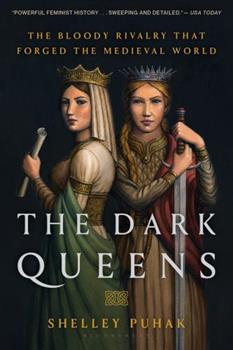 Book: The Dark Queens
Author: Shelley Puhak
Description: The book follows the lives of the Frankish sisters-in-law and queens, Brunhild and Fredegund, who lived in the late 6th and early 7th centuries (that’s the late 500s and early 600s for my non-history fans).
Myrmigrade: 


The Pros
Just in case you don’t get to the end, I’m going to start with the positives.
First, the story is incredibly intriguing. It basically writes itself, and I’m grateful that Ms. Puhak took the time to compile the primary and secondary sources into a coherent narrative. I also applaud the fact that she did this – she is not a historian, but she saw a gap of knowledge and felt compelled to fill it.
Good for her. And on the whole, she told a good story, albeit a sad one.
The Cons
And the story is very sad. It truly lives up to its name. It just left me feeling unsettled. Everyone was utterly despicable, except for possibly Queen Brunhild. I liked Brunhild a lot, and it was her death that unsettled me the most.
However, that’s not why I gave it a 2.5 rating. I’m afraid I’m going to sound like a MAJOR snob, but there were some MAJOR red-flags that – from a historical point of view – made me cautious in accepting much of Ms. Puhak’s analysis.
Ms. Puhak is a poet, which means she is not trained to be an academic historian. Unfortunately, the gap in her training shows. To be fair, she understands this. She admits in her “Note on Sources and Methods” that “this book is not an academic history; it is a work of narrative nonfiction based on primary sources.”[1]
The problem is, that’s not very helpful, and I’m not even sure it’s a thing. If it is a thing, it’s not a very helpful thing.
I mean, it’s a nice concept, but to be taken seriously and to be believable, there needs to be a high level of academic integrity. Meaning, guesswork on motivations need to be clearly marked; biases need to be at a minimum; and for the love of all things good and true, FOOTNOTES MUST BE USED.
Ok, maybe I’m the only one who was incredibly upset by the last part. But the footnote system is an interdisciplinary feature. It doesn’t have to be perfect…but making up your own system makes it look like you have no idea what you are doing.
Guesswork and Bias
From what I could tell, she does seem to ear-mark when she guesses about motivations. However, she did not try and curb her biases. This means she’s 1 for 3 on my criteria on historical trustworthiness. (Which makes me wonder if she did earmark all her guesses as well as she should have.)
Her bias is especially evident when discussing the church. I would describe her as antagonistically skeptical towards church matters, whether that’s ecclesiastical doings or a person’s piety. To be fair, the church was far more involved in politics than it should be, and church leaders DID do things out of personal interest rather than for God. However, I’ve read a lot of historical accounts from medieval times, and none of them approach faith or the church in such a skeptical manner. (If you’re curious about some analysis on this topic, see my review for Bullies & Saints.)
I had an example of how her bias against the church majorly skewed her analysis – but I don’t want to seem like I’m trying to drag her down. After all, she did a lot of work on this, and I respect that. Suffice it to say that if there are clear biases, it skews analysis. And if analysis is skewed in one way, then it’s hard to take everything else seriously.
To sum up, as an historian, I felt her analysis was skewed, and then wondered if there were other biases and analysis that I had missed. It just felt like I couldn’t truly trust her work.
Seeking God: The “Characters”
I really liked Queen Brunhild. Regardless of Ms. Puhak’s thoughts on the church and piety, Queen Brunhild seemed to be genuine in her faith. She was kind to the Jews in her territories,[2] and she funded a missionary journey to England.[3] I also admire how she fought to protect her children, grandchildren, and great-grandchildren.[4] Ferdegund also fought for her sons, but she was more cruel in her methods. (And she did try to kill her daughter by shutting her head in a chest…so there’s that.)
As for every other major player in the book? Awful. It’s has “dark” in the title for a reason. Maybe it was the lens through which the tale was written, but on the whole, I found the actions of the powerful men to be consistent with slightly later time periods. Which is to say, they were unashamedly cruel and terrible, to everyone.
So where is God in this?
The more I read of history, the more convinced I am that heaven’s history will be completely different. I think we’ll be learning about a whole new, mostly unheard of, list of major players in world history. And after reading this, I truly thank God for that.
And honestly, I’m not sure any of the people on this list would make the heavenly history list. Then again, that’s what grace is for. So maybe I’ll be wrong.
Seeking God: The Treatment of Women
Ms. Puhak talked about how Queens Brunhild and Ferdegund were systematically silenced, sometimes erased from history completely or otherwise downplayed significantly.
Unfortunately, this hasn’t changed.
We just had a high-profile domestic dispute between Amber Heard and Johnny Depp. Regardless of which “side” you’re on, the way the media tried to silence Amber through mockery is simply disgusting. Or, take for example the Southern Baptist Convention’s (SBC’s) handling of sexual assault cases – how they “mistreated and intimidated survivors” into staying silent.
The silencing of women is an age-old problem. The good-ish news is that such practices pre-date Christianity. That means it’s not a Christian problem – it is a human problem. It just looks uglier on Christians because, honestly, we should know better.
Jesus did not silence women. The gospels are full of women using their voice to extort him (Mark 7:24-30), to praise him (Matthew 26:6–13), and to tell others about him (Luke 24:1-12). The Gospels also show Jesus protecting women (John 8:1-11), talking with women (John 4:1-42), and teaching women (Luke 10:38-42). Some of these episodes are strange (like calling the one woman a dog), but this has more to do with the cultural complexities of the time. (And he wasn’t calling her a dog. He was referencing how Jews generally thought of Gentiles – and he was also probably trying to get through to his disciples that there IS no difference between Jew and Gentile. Ok, end mini-sermon.)
Jesus did not erase women from history. He didn’t silence their cares. So why do we continue to do so?
That’s why I (generally) enjoy history books like these. They give voice to women from the past, and they help us see similarities in our own times. Hopefully, we will not repeat the past.
Notes
[1] Puhak, Shelley. The Dark Queens: The Bloody Rivalry That Forged the Medieval World. New York: Bloomsbury Publishing, 2022, 271.
[2] Ibid. 246.
[3] Ibid. 235-236.
[4] Basically the whole book, so I won’t bother with a page number.


